
Who is involved?
The St. George Leadership Association is a professional confraternity of serious Catholic men and women — including Eastern and Western Catholics — on both sides of the Atlantic. We stand together, support one another, and learn from one another to grow in faith and in our commitment to virtue and excellence in every dimension of life — professional as well as personal. We share insights, ideas, and inspirations that often lead to collaborations and new opportunities, strengthening each other in our common mission to lead with integrity and purpose in the modern world.

Founder: Dr. Mikaël Grisvaldi-Thompson
Dr. Mikaël has been a keynote retreat leader for the worldwide Tepeyac Leadership Initiative since the beginning in 2018, and is a Lecturer at Vistula Business University in Warsaw, Poland. He previously served as President of the Virtuous Leadership Institute and for the last 20 years has worked extensively across Europe and North America, forming Catholic leaders at the intersection of faith, leadership, and culture,
As a Maronite Catholic, he is strongly formed by the richness of the Syriac theological tradition. Originally from a culturally diverse background, Dr. Mikaël lives with his wife and children in central Italy.
Dr. Mikaël has been featured in the Knights of Columbus Film Into the Breach, the Bearded Virtue podcast, and The American Conservative, among other channels.

Catholic professionals like You.
As a Catholic called to lead, you’re not on the sidelines—you’re already in the arena. The St. George Leadership Association is a fraternity of Catholic professionals who take the mission seriously—who lead in the world without losing their soul.
Other Catholic professionals are stepping forward, locking arms, and building something that lasts. You’ve been formed. Now it’s time to act. Join us—and together, we will carry the Church’s mission into every corner of the society. We stand in our workplaces, in education, and in public service—not as spectators, but as witnesses to Christ, and Christian leaders not only in name, but in deed.
Our Patron: Why St. George?
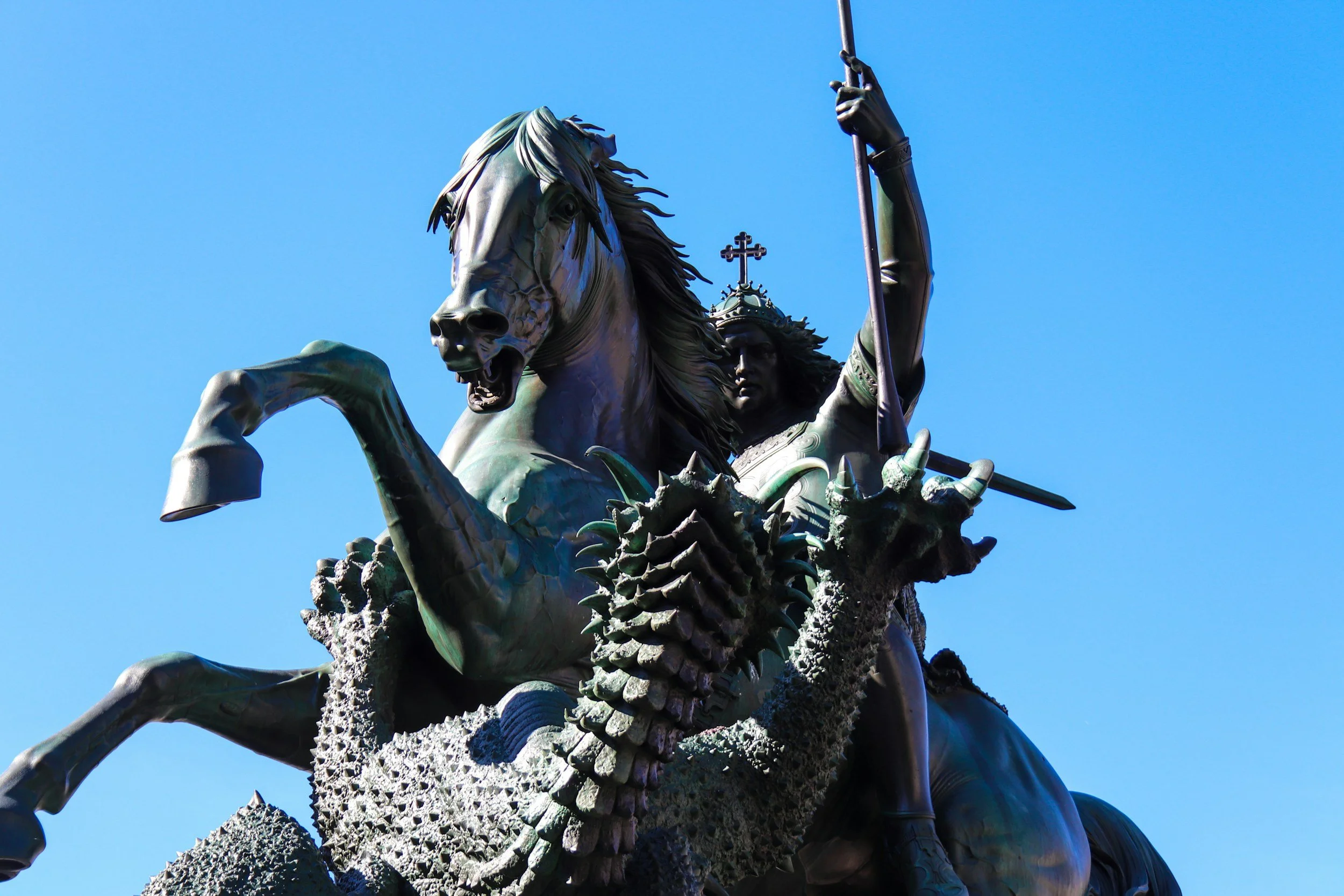
St. George, as we all know, is the saint who slayed the dragon. And the thing we learn specifically from St. George is how to slay the dragon without becoming the dragon. What do I mean by that? You know, often in society today we see dragons, we want to fight the dragons, and we try and fight the dragons by another dragon ourselves — we become a dragon inside, we unleash a dragon inside. But this takes us away from Christ, not closer to Him. When we see something online and spew invective, or just simply get ourselves worked up and angry or anxious, or depressed by what's going on around us, we've “drunk the dragon's blood,” to use the imagery that the Desert Fathers love to use when they talk about anger as one of the capital sins. They say that this kind of wrath, this resentment and bitterness—or the paralysing depression and anxiety—is like dragon’s blood that corrodes us and only worsens the state of the world we live in.
St. George, instead teaches us how to slay the dragon without becoming the dragon. How does he do this? Well, he first of all does set out to slay the dragon merely for his own glory and gain, nor does he do so of his own power alone, but he does so only with the power of Christ, and using all the material and personal means at his disposal. He rallies the people troubled by the dragon and leads them, he serves them, to free them from the clutches of this evil thing. He does so to rescue the princess — a classic image in all the fairy tales, which is a symbol of the Church (or the individual soul) as the Bride of Christ.
But here’s the most powerful witness of what it means ultimately to not become the dragon: We all know St. George’s dragon-slaying story, but what many people today don’t know, is the fact that St. George is a great martyr. He suffers a gruesome and yet mystically glorious martyrdom for the sake of Christ. He is called Megalomartyrios in Greek. That is, The Great Martyr. St. George, The Great Martyr — the Great Witness of Christ. He slays the dragon by becoming a martyr out of love, by witnessing to Christ, loving Christ, loving man, loving his fellow human beings for the sake of Christ, and dedicating himself to transform the society around him in the light of the Gospel.
That is how the dragons of our own day can be slain. The only way. So may St. George continue to be a light and an example for us to go out into the world, though we may face trials and difficulties, and even persecution and death, in order to take up the banner of Christ in the world around us and answer the Gospel mandate to lead where none will lead, to speak the truth where others speak deceit, and to labour faithfully for the Kingdom of God.